Every school has an emergency plan. Fewer have a shared vocabulary for one.
That's what the Standard Response Protocol (SRP) and Standard Reunification Method (SRM) provide. They give every adult and student on campus, along with every first responder they'll ever work with, a single common language for what to do when something goes wrong. When seconds matter, common language isn't a soft benefit. It's the difference between a coordinated response and a fragmented one.
For independent schools, adopting SRP and SRM is not about complying with a state mandate, though some states now require it. It's about closing the gap between the plan on paper and the practice on the ground. This guide explains what SRP and SRM are, why they matter for independent schools, and what implementation looks like from the perspective of a Head of School, Director of Operations, or Director of Technology.
What is the Standard Response Protocol (SRP)?
The Standard Response Protocol is a framework developed by The "I Love U Guys" Foundation, a nonprofit founded in 2006 in the wake of a school shooting tragedy in Colorado. Ruvna formalized a partnership with the Foundation in 2026. It's now used in more than 78,000 schools, districts, agencies, and organizations worldwide.
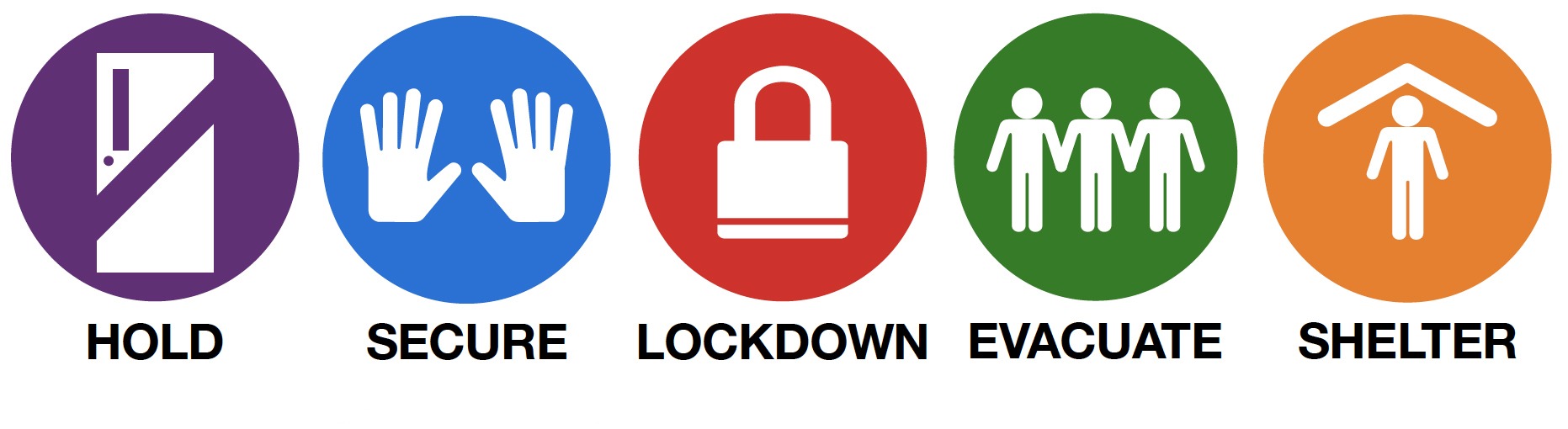
SRP is built on a simple principle: rather than color codes ("Code Red," "Code Yellow") that vary school to school, SRP uses five plain-language actions that mean the same thing everywhere they're used. When a first responder from an outside agency arrives at your campus, they know exactly what "Lockdown" means because SRP schools all use the term the same way.
The Five SRP Actions
Hold
Used when hallways need to stay clear. Students and staff remain in the classroom or space they're currently in. Business continues as usual inside the room.
Typical use case: a medical incident in the hallway, a maintenance issue, a brief disruption that shouldn't affect ongoing instruction.
Secure
Used when a threat exists outside the building. Everyone comes inside, exterior doors are locked, but instruction continues normally indoors. This is not a lockdown. Students and teachers keep working.
Typical use case: police activity in the neighborhood, an incident nearby.
Lockdown
Used when there is a threat inside the building. All students and staff move out of sight, lock doors, silence phones, and remain quiet until law enforcement or administration tells them otherwise. This is the highest-stakes SRP action.
Evacuate
Used when the building needs to be emptied. Students and staff move to a designated location, either on or off campus, following pre-established routes.
Typical use case: fire, gas leak, structural concern.
Shelter
Used when specific protective actions are needed for a specific hazard. This includes sheltering for tornadoes, hazardous material events, or earthquakes. Unlike the other actions, Shelter is often paired with a specific hazard type (Shelter for Tornado, Shelter for Hazmat) so the response matches the threat.
Why Plain Language Matters
SRP uses plain language rather than codes for operational reasons, not stylistic ones. It's operational. If a substitute teacher, a maintenance worker, or a parent volunteer is on campus when an emergency happens, they need to know what to do immediately. "Lockdown" is self-explanatory. "Code Blue" is not.
For independent schools, where visiting alumni, prospective families, board members, and vendors are on campus regularly, this matters even more. A visitor should understand what's happening in a crisis without needing a briefing on your school's specific color coding.
What is the Standard Reunification Method (SRM)?
If SRP tells you what to do during a crisis, SRM tells you what to do after. Specifically, it tells you how to return students safely to their parents or guardians when a crisis requires it.
Reunifications happen more often than most schools realize. Power outages, weather events, hazmat incidents, threats near campus, or any situation that requires students to leave school outside of normal dismissal all trigger some form of reunification. Most reunifications are non-traumatic. But almost none are simple, because the process is inherently high-stakes: chain of custody must be maintained, parents must be verified, and the environment is usually chaotic.
SRM provides a structured, repeatable method for handling reunification that reduces confusion, protects the chain of custody, and helps parents and staff move through a stressful situation as calmly as possible.
The Four Stages of SRM
Notify
Parents receive a message about the reunification. The message tells them what happened, where to go, what to bring, and what not to bring. SRM recommends the "27/9/3 rule" for these messages: 27 words that can be spoken in about 9 seconds. Short messages travel further under stress.
Check-In
Parents arrive at the reunification site (which may not be the school itself) and line up alphabetically by student last name. They complete a reunification card that captures identity information and custody status. Staff verifies parent identity against emergency contact and custody records.
Reunify
Once verified, staff move parents to a separate reunification area. A runner takes the bottom portion of the reunification card to the student assembly area and retrieves the student.
Follow-Up
Every reunification is documented. Cards are retained, students who could not be reunified (parent unavailable, custody issue) are tracked, and lessons are captured for the next drill or event.
Why Chain of Custody Matters
The heart of SRM is chain of custody. In a normal school day, the school is legally and morally responsible for every child in its care. That responsibility does not pause during an emergency. If a reunification is chaotic, students can be released to the wrong parent, an unauthorized adult, or (in rare but real cases) end up unaccounted for.
A structured method ensures that, no matter how emotional or fast-moving the situation, the school never loses track of who's on campus or who each student has been released to.
Why SRP and SRM Matter Specifically for Independent Schools
Many public districts have adopted SRP through state mandate or district-wide policy. Independent schools can adopt SRP voluntarily. That freedom is both an advantage and a challenge.
The advantage: independent schools can adopt SRP and SRM cleanly, without the layered legacy systems and inter-district variation that complicate public district adoption. A K-12 independent school with 300 students can standardize on SRP in a single year with focused effort.
The challenge: many independent schools have historically relied on their own bespoke emergency plans. These plans may work well internally, but they don't align with the language your local first responders speak. When a police officer arrives on your campus during an emergency, they'll operate in SRP language even if your school isn't. That mismatch matters.
Three reasons independent schools should adopt SRP and SRM specifically:
1. Alignment with first responders: Local police, fire, and EMS agencies are increasingly SRP-trained. A response coordinated in a shared language is faster.
2. Parent expectations: Parents at independent schools have high expectations of the safety infrastructure they're paying for. SRP and SRM adoption is a concrete, communicable commitment. It's something you can point to in an admissions conversation, a board meeting, or a parent town hall.
3. Peer school benchmarking: Independent schools benchmark against each other constantly. SRP is becoming the peer-recognized standard. Schools that haven't adopted it will increasingly look behind on safety infrastructure when compared to peers who have.
Common Questions About SRP and SRM
→Is SRP a mandate? Not federally. Adoption varies by state. Some states, such as New York, have formally adopted SRP as a recommended framework. Others are moving in that direction. Independent schools generally aren't bound by these mandates, but many adopt SRP voluntarily.
→Do we need to abandon our existing emergency plan to adopt SRP? No. SRP replaces the language of your response actions, not the underlying plan. Your building-level emergency response plan, evacuation routes, reunification sites, and communication trees can all remain in place. What changes is the vocabulary used to activate them.
→How long does implementation take? For an independent school with focused leadership, adoption can happen in a single school year. The Foundation offers half-day and full-day training options, including Train the Trainer certifications that authorize your team to train staff and students internally.
→Is training free? The "I Love U Guys" Foundation's materials are free to download and use. In-person trainings from the Foundation may have costs associated. Many schools train internally after one leader completes Train-the-Trainer certification.
→How often should we drill SRP and SRM? Drill SRP actions with the same cadence as your existing fire and lockdown drills. Most states require some combination of monthly to quarterly. Drill SRM reunifications at least once per school year, ideally in conjunction with a broader emergency exercise.
→What technology do we need to support SRP and SRM? No technology is required to adopt SRP or SRM. Several tools, though, make them easier to carry out when you're coordinating an entire campus. Mass notification systems for the Notify stage of SRM. Real-time accountability systems for tracking students during an action. Visitor management systems so you know who else was on campus when an action was called.
→Can students be released to non-parents during a reunification? Only to individuals previously identified as emergency contacts, and only after identity verification. High school students can sometimes be released to themselves depending on school policy and the specific event.
→What's the difference between SRP and the older lockdown drill? Lockdown is one of the five SRP actions, not the whole framework. Traditional lockdown drills often mixed "shelter in place" with "lockdown" in confusing ways. SRP separates them clearly. Hold, Secure, Lockdown, Evacuate, and Shelter each mean specific things and are triggered by specific situations.
What Implementation Looks Like
For a Head of School or Director of Operations considering adoption, the path typically looks like this:
Phase 1: Leadership decision and training
The head of school, director of operations, or head of safety attends a Train the Trainer workshop through The "I Love U Guys" Foundation. This certifies them to train the rest of the school internally.
Phase 2: Staff training
All faculty and staff receive SRP training. This includes teachers, admin, coaches, kitchen staff, facilities, and any adult on campus during the school day. The Foundation provides materials at no cost.
Phase 3: Student and family communication
Age-appropriate SRP education for students. A clear communication to parents explaining the framework, what actions mean, and what they should do during each one.
Phase 4: First responder coordination
Meetings with local police, fire, and EMS to confirm they operate on SRP language and coordinate response protocols. Some agencies may want to conduct joint drills.
Phase 5: Ongoing drills and refinement
Regular practice of all five SRP actions and at least annual SRM drills. After-action reviews to refine the practice.
Where Technology Fits In
SRP and SRM are frameworks, not tools. But they benefit from tools that reduce execution friction.
- For the Notify stage of SRM, a mass notification system that reaches parents on their preferred channels (text, email, app push) with the 27/9/3 message.
- For chain of custody during a Lockdown or Evacuation, a real-time accountability system that gives staff a live picture of who is present, who is not, and where students are.
- For campus awareness during any SRP action, a visitor management system that shows who else is on campus when an action is called, so staff can account for them alongside students.
Ruvna is a Software Integrator with The "I Love U Guys" Foundation, and our platform is designed to make SRP and SRM execution simpler for independent schools. But the frameworks are freely available, and the most important adoption work isn't buying technology. It's the training, the communication, and the drills.
Getting Started
If your school hasn't adopted SRP and SRM, three practical next steps:
- Visit iloveuguys.org and download the current SRP and SRM materials at no cost.
- Identify one senior leader who can attend a Train the Trainer workshop.
- Set a target adoption timeline (typically one academic year) and build backward from there.
Every school has an emergency plan. The schools that stay calm during real events are the ones that share a language for how to execute it. SRP and SRM give you that language.

Latest articles
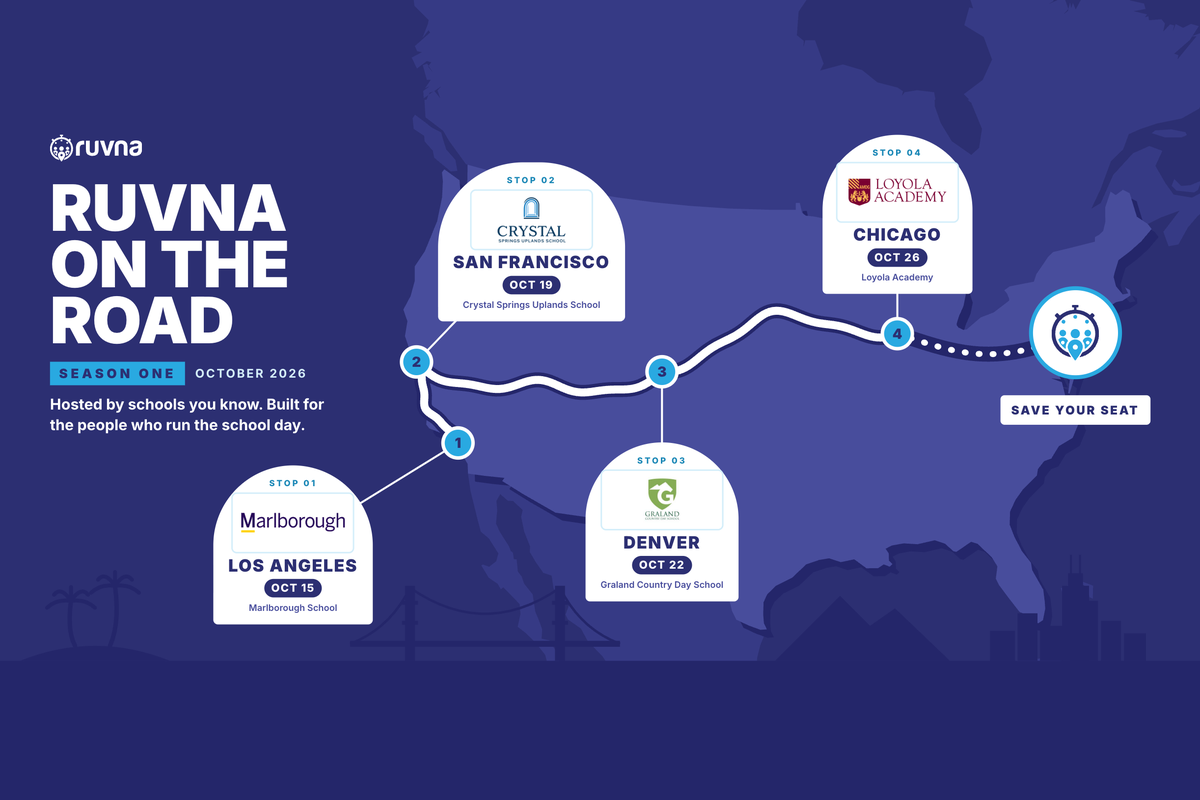
Ruvna on the Road, Coming to a Campus Near You

What The First Six Weeks Of School Can Tell You That June Can't