


Most schools evaluate a drill the way they'd evaluate a performance. Did it go smoothly? Was the timing better than last year?
Those are fair questions. They're also not the ones that produce the most value in September. The first drills of the year are the only moment when a new roster, new faculty, updated procedures, and families still learning how the school communicates all get tested together. Alongside whatever they confirm is working, they produce a list of things nobody knew needed attention.
And that list looks very different depending on which drill produced it.
Two Schools, Two Very Different Campuses
The two leaders in this conversation work with very different logistics, and they arrived at the same conclusion about what a drill is for.
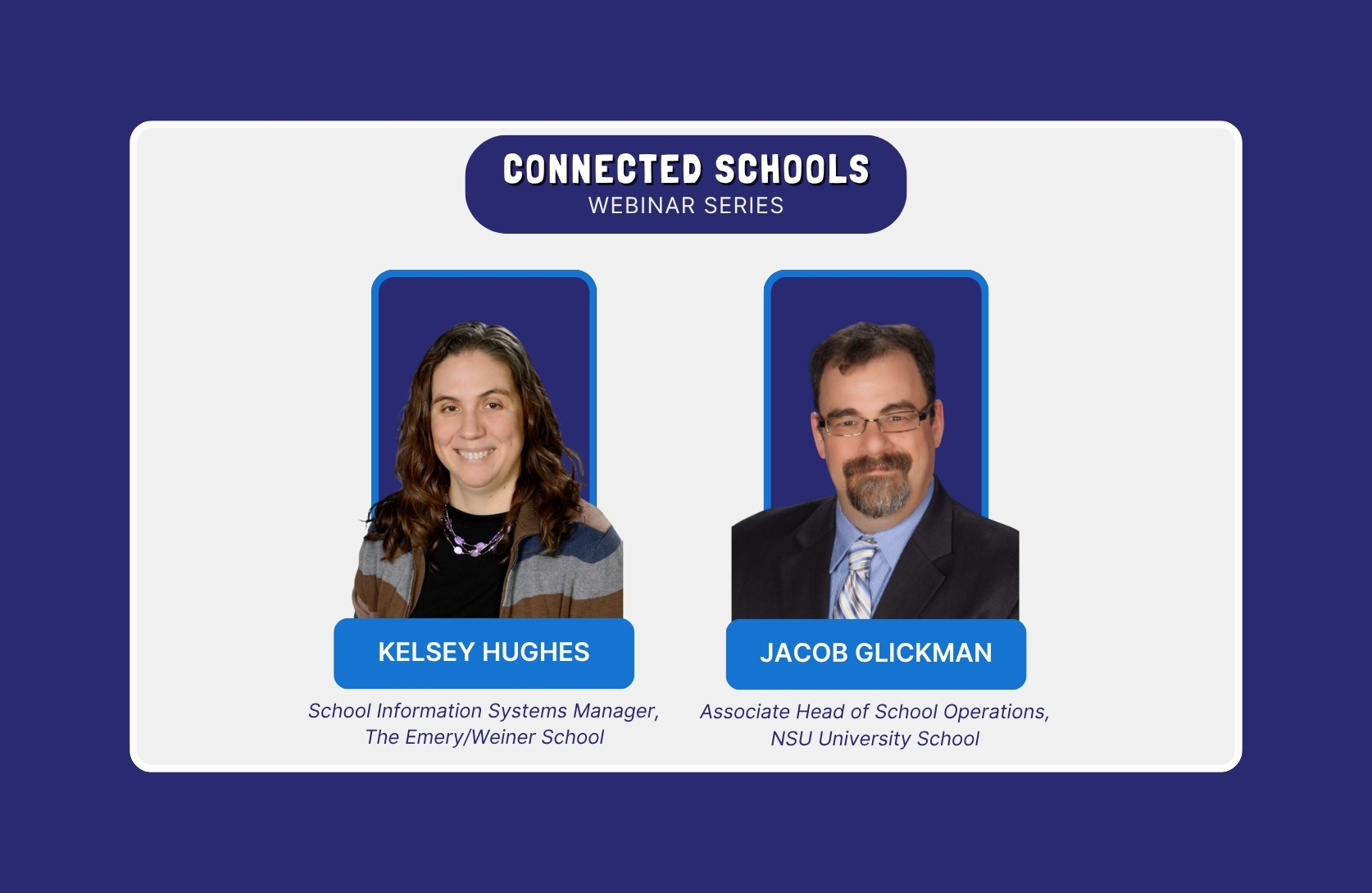
Jacob Glickman is Associate Head of School for Operations at NSU University School in Fort Lauderdale, a PK-12 school of roughly 2,000 students across seven buildings. His role covers essentially everything outside teaching and learning, from admissions and communications to technology, HR, and safety. Drill planning at that scale involves the school's public safety partners and local school resource officers, and an all-school lockdown means coordinating interior and exterior sweeps across the entire campus.
Kelsey Hughes is School Information Systems Manager at The Emery/Weiner School in Houston, an independent Jewish day school serving grades 6 through 12 with about 700 students and growing. She runs the school's systems, which means the calendar, the student information system, the displays, and the safety platform all sit with her. Drill coordination runs through a group of about five people.
Where the Formative Framing Comes From
One campus spans seven buildings. The other sits on a single site. Both start from the same place.
Jacob puts drills in the same category as a formative assessment. The purpose isn't to demonstrate mastery. It's to locate the edges of it.
"One of the things we talk about all the time is it's OK if things go wrong in the drill. In fact, we want that. We want to know where there are gaps, where there are faulty assumptions, where there are areas of opportunity."
Kelsey frames it the way faculty already frame a low-stakes quiz for students.
"This is to figure out what you don't know yet and what you need to do better. And so if you go into it expecting something perfect, you're going to be disappointed."
Kelsey was explicit that both halves matter. Here's what went great, and here's what we now know to work on.
What the Fire Drill Surfaced
Fire drills run on an established rhythm. Emery/Weiner runs one every month starting in August, so the first of the year lands on a cadence faculty already know. These drills tend to surface findings about process and speed.
At NSU University School, the lower school accounted for 750 students in 12 minutes. The gain came from removing a dependency, not from people moving faster. Confirming groups across a large campus with a parking garage had meant relying on walkie-talkies and on who could hear whom.
At Emery/Weiner, faculty had previously carried a red folder out to a yard line, taken attendance on paper, and waited for an administrator to reach them. This year the whole thing happened on a phone. Kelsey's read was that people weren't moving between groups anymore, and nobody was held up because a folder had been left inside.
The rest of that drill's list was small and specific. One faculty member's setup went wrong, and the person next to them submitted attendance for both groups. A substitute had been given information that turned out to be incomplete. Two faculty members without a class that period hadn't realized the process applied to them.
None of that is dramatic. It's also exactly what only appears when you actually run the drill.
What the Lockdown Drill Surfaced
The lockdown list was different, and part of why is that lockdowns have historically been harder to get visibility into than evacuations. Faculty secure their rooms, and the picture comes together once the all clear sounds. By leveraging technology, both schools were seeing that sequence change for the first time this year.
Start with what the timing measures. At NSU University School, the length of the lockdown drill has almost nothing to do with how quickly faculty work. It's governed by how long evaluators and public safety need to clear interior and exterior spaces across seven buildings. Speed was never the interesting number.
The interesting number was 96 percent of students accounted for, with absences already factored in. Chasing the remaining four percent led back to a group of faculty whose setup hadn't been completed correctly, so their attendance never submitted. Nobody had reason to suspect it beforehand.
At Emery/Weiner, Kelsey had explanations within about ten minutes. Two groups of students hadn't been checked in, and in both cases the reason was immediately traceable: one to a substitute's login, one to a setting on a single device. She walked both to her upper school and middle school administrators that morning, with the answer already attached.
The structural finding was harder. Emery/Weiner is a phone-free campus where sophomores through seniors sign in to one of five study hall locations, and a few of those spaces didn't have an adult present. In a fire drill, that resolves itself, because students know which faculty member to find. In a lockdown, it becomes a scheduling decision.
The Finding Neither School Expected
The most surprising result at both schools had nothing to do with the count.
During a lockdown, faculty are behind closed doors with their students and have no sense of what's happening elsewhere. Both schools had asked faculty not to text each other during a lockdown, for sound reasons. This year, for the first time, they had a channel that was part of the drill itself.
What came through it was ordinary and useful. A faculty member flagging that a student marked present was probably absent, and a colleague confirming it. Someone noting a student was accounted for in her room. At Emery/Weiner, a faculty member asking what to do about a student in a restroom that doesn't lock. Kelsey ran a separate channel for administrators alongside the general one, so updates went out at a steady rhythm.
The feedback afterward went somewhere neither leader anticipated.
"They felt better about the drill and safer during the drill because they didn't feel isolated," Jacob said.
That won't appear in a drill report. It may still be the thing that shapes how faculty approach the next one.
Two Debriefs, Same Cadence
A debrief doesn't have to look a particular way to do its job. One of these schools has seven buildings and roughly 2,000 students. The other has about 700 on a single campus. Both run a debrief within days, and each builds a version that fits the school they're actually running.
At NSU University School, the planning team and the debrief team are the same group, which is deliberate. Jacob, the school’s public safety and emergency management teams, the security staff, and the resource officers all scope the drill together and build the form evaluators carry during it. Immediately after the all clear, that group meets for a hot wash, the standard term for an on-the-spot after-action discussion, while reactions are still unfiltered. Within the week they reconvene to work through lessons learned, sort recommended actions by feasibility, assign timelines, and decide what the next drill should be. That process follows lockdown and evacuation drills rather than the monthly fire drills.
Emery/Weiner runs the same loop at a different scale. Kelsey pulls the data, walks it to the four or five people who need to see it, and asks what they noticed. An email to faculty follows before the next drill flagging a few things to watch.
Neither version is the compromised one. Both protect the same thing, which is that findings get discussed while they're fresh and turn into a decision about what happens next. And what surfaces is rarely about individuals. It's systemic, or about communication, or about the physical plant. A substitute who wasn't trained. A script that hadn't been updated. A study hall without an adult. Those have owners, budgets, and timelines, which is another way of saying they're solvable.
How the List Lands Is a Leadership Decision
Jacob made a point during the conversation that only a leader in his seat can make. From a certain point of view, he said, a drill where nothing surfaces isn't really what a school wants, because there's nothing to learn from it. He was clear that senior leaders setting that expectation out loud is what makes the difference, because it trickles down.
When that framing is explicit, the debrief becomes a partnership conversation. Division directors hear actionable improvements. Faculty raise the small thing they noticed instead of leaving it unsaid.
Listen to Kelsey and Jacob’s full conversation, including how they prepared their communities beforehand and what each is changing next. Watch the recording of Everyone Accounted For?: What Independent Schools Learned From Their First Drills of the Year.
For a closer look at Accountability, Joey Nutinsky, our CEO and co-founder, is walking through it live on October 8th as part of our Ruvna in Action series. You can save your spot here.

Latest articles

Built to Scale, Managing Campus Safety Across a Growing School Network

The Independent School Guide to the Standard Response Protocol and Standard Reunification Method
.jpg)