When weather changes the school day, the decision itself can come together in minutes. What takes real preparation is everything after it: a message that reaches every family, in the right order, before their morning begins.
Two independent schools show what that preparation can look like. Alex Ladstatter is Director of Communications at The Country Day School in McLean, Virginia, a school of about 265 students in pre-K through kindergarten, where snow and ice are the most common reasons for a delay. (We covered Country Day’s first snow delay last winter in an earlier post.) Stacey Gonzalez is Director of Communications at NSU University School in Fort Lauderdale, Florida, a school of about 2,100 students from age 18 months through grade 12, where lightning storms and hurricanes are the typical events. Their schools differ in size, age group, and weather, and their playbooks still share a lot of common ground, so school leaders of any size can take something from them.
Start the Conversation Early, With a Small Group
The most reliable weather decisions begin before the alarm goes off. At both schools, the head of school kicks things off, usually with a group text the night before, and a small group weighs in from there.
At NSU University School, that group includes the head of school, two associate heads, the directors of each division, and Stacey. When flooding closed schools across her county, the conversation began the evening before, after more than 24 hours of steady rain. Because the school is part of Nova Southeastern University, the team also consulted the university’s president, who agreed with their proposed closure.
At Country Day, Alex described a team where “each department is one person.” The group watches local news, the forecast, and the National Weather Service Doppler hour by hour, and checks with faculty who live across the region, from the DC area to near the mountains of West Virginia. “It’s a group text at 5 in the morning when we’re all trying to make a decision,” Alex said.
Neither school runs its own transportation, so the decision comes down to whether families and staff can get to campus safely. For NSU University School, that includes high school drivers and families who travel up to an hour.
Draft the Message Before the Decision Is Final
Templates turn a message written under pressure into a message that only needs adjusting. Both schools keep them for the situations they see most, and they start using them early.
“The second we even think about an emergency, I already have a message drafted,” Stacey said.
She added that anyone with the time to build templates should, because they can be adapted to the situation. For the flooding closure, she adjusted a hurricane template and had it ready in Ruvna before the final OK came through.
Alex’s school keeps templates for lightning, a one-hour delay, a two-hour delay, and a snow closure, plus one to fill in for anything else. One of their first weather messages in Ruvna was a lightning alert he typed on his phone at the front door, and he could watch the carpool line start to move.
Keep It Short and Say What Families Need to Do
Families open a weather message looking for one thing: what to do next. Alex keeps his messages brief, with a simple salutation and then the details families need. A delay affects morning classes, and a closure may mean arranging childcare. Stacey agrees there’s little room for extra detail, other than a line on the school’s commitment to safety.
A closure reaches well beyond the classroom. “When we close a school, it’s more than just not having classes,” Stacey said, pointing to athletics, after-school activities, and arts programs. When flooding closed her school, her first message simply announced the closure. Shortly afterward, she sent a separate message to pre-K3 families about a parent event, selecting only that audience in Ruvna.
Reach Everyone at Once, and at the Same Time
Families check different things at different times. When NSU University School sends a closure message, it goes out as a text, an email, and a voice call. “Some people just don’t look at their texts. Some people answer a phone call when it comes in,” Stacey explained.
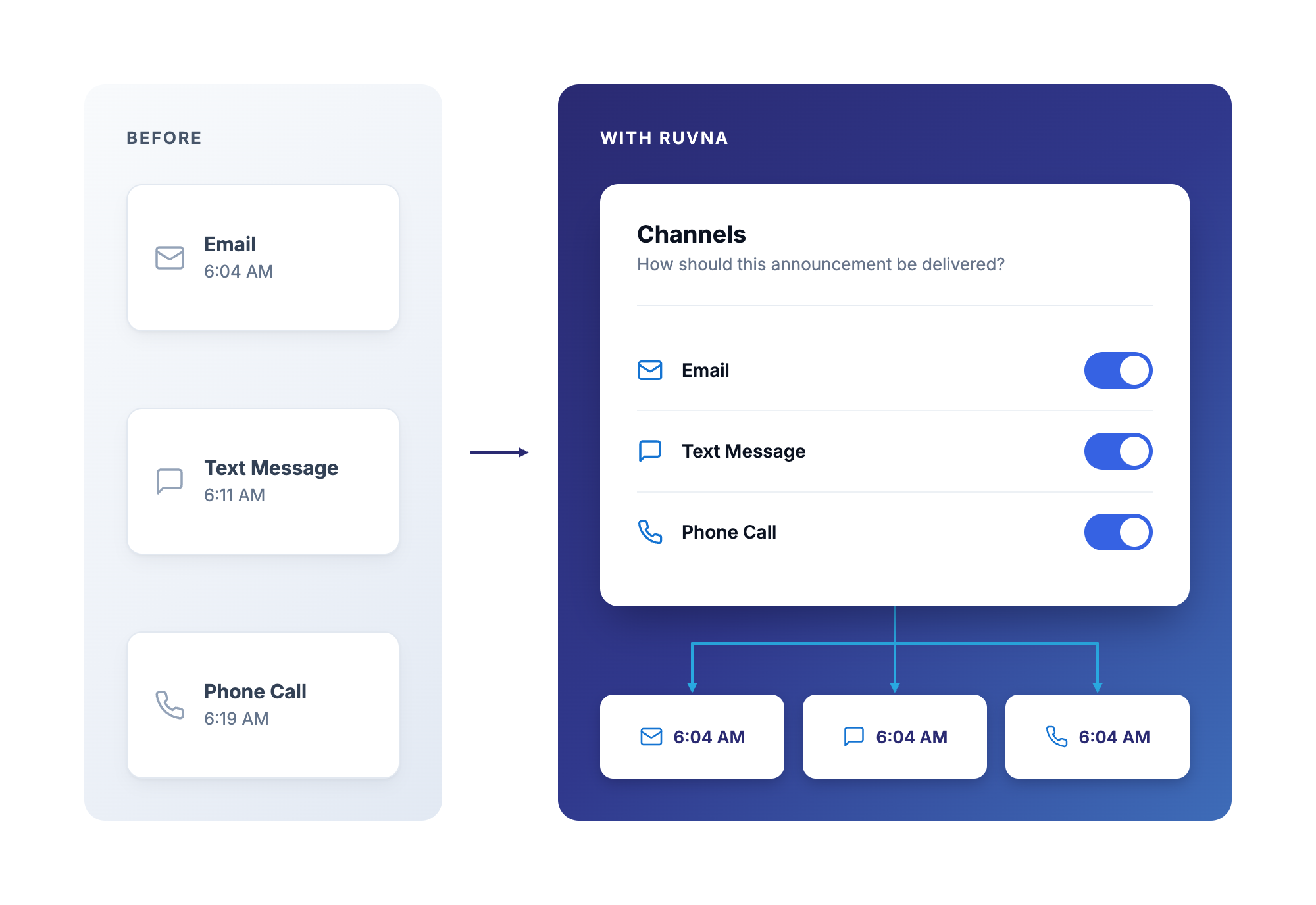
It wasn’t always this simple. Stacey used to send a mass email, an automated call, and a text through three separate platforms, a time-intensive process for the one person handling emergency notifications. Alex’s school relied mostly on email before Ruvna, and he noted that “people need that immediate hit when it comes in.”
Order matters too. Stacey asked her division directors to hold their staff message for about two minutes so faculty and parents hear at the same moment. “For us, it’s important they both go together,” she said, so families aren’t left wondering which message to believe. Alex’s team lets faculty and staff know first. Whichever order a school chooses, it helps to decide it ahead of time.
Identify Your Decision Makers, Then Trust Them to Make the Call
Weather days go more smoothly when everyone knows who has the final word. For a delay or a closure, both schools have that clear. At Country Day, the head of school calls it after the team weighs in. At NSU University School, the team proposes a closure to the university president.
Some recurring events call for a different owner. Lightning is common in South Florida, so NSU University School handles it separately from a closure. When lightning is within six miles, dismissal moves indoors, and parents leave their cars in the carpool lane and come inside with ID. The team checks conditions 15 minutes before dismissal and sends a text and a call about five minutes before, with no email, since this message needs to be seen right away. Country Day takes a similar approach when a fall or spring storm brings lightning to Virginia: parents come inside with ID to pick up their children, and no faculty or students wait outside.
At NSU University School, the director of after-school activities, who runs carpool, owns the lightning call. He posts in a chat that the school is under a lightning alert, and Stacey sends the message. It’s the one recurring event where the leadership team doesn’t make the final call, and Stacey described what that takes: “I have to leave it in his hands and trust that it’s in his hands.” She asks the same of her head of school when it comes to crisis communication.
“In the event of an emergency, everyone feels they know best,” she said, “and I think that you have to have a clear sense of who is ultimately going to make the decision.” Her advice to school leaders: “encourage the experts to be experts.”
When Plans Change Midday
Midday changes call for the same preparation. At NSU University School, an air conditioning outage can mean calling for early pickup, so Stacey’s team staggers it: middle school by noon and high school by one, to keep traffic flowing. At Country Day, a snowfall can start light and begin accumulating. The team starts with a text, often meets in person, and once the head of school calls it, the template goes out.
Prepare Before the Season Starts
Both schools prepare families ahead of time. Stacey explains at orientation that the school won’t message families until a plan is in place and students are safe, and her team sets a standard time for lightning alerts. For hurricanes, the school keeps a web page and a hotline that say “we’re monitoring the situation” well before anything is certain.
Alex tests his system with families twice a year, at the start of the year and again before winter. A day before each test, he lets families know a mass text, call, and email are coming, so they can check spam folders and update phone numbers.
“Don’t be afraid to schedule tests if you feel like you need that peace of mind,” he said.
Stacey also suggested bringing the decision-making group together on a professional development or teacher work day to talk through scenarios, with the communications lead taking notes.
Takeaways to Bring Back to Your Team
- Know who makes the call, and who can make recurring calls on their own.
- Draft ahead with templates for each scenario.
- Keep it short, and say what families need to do.
- Send across channels at once, and decide ahead of time when staff and families hear.
- Set expectations and test before the season starts.
This post draws on our Connected Schools webinar with Alex and Stacey. Want to hear the full conversation? Watch the recording to hear Alex and Stacey walk through their examples in their own words.
Tell us what you want to hear about! Help shape our Connected Schools conversations in 2027 by sharing the topics you’d like us to cover and the guest speakers you’d like to hear from.

Latest articles

What’s Actually Inside the AI Tools Being Pitched to Your School

Ruvna on the Road, Coming to a Campus Near You